Showing posts with label Travel The Oldest City In The World. Show all posts

Monday, September 19, 2011

Travel Sana'a City, Yemen

Sana'a is the capital of Yemen and the centre of San‘a’ Governorate; however the city itself is not part of the Governorate, but forms the separate administrative district of "Amanat Al-Asemah".

Sana'a is one of the oldest continuously inhabited cities in the world. At an altitude of 2,300 metres it is also one of the highest capital cities in the world. Sana'a has a population of approximately 1,748,000 (2010) making it Yemen's largest city. The old city of Sana'a, a UNESCO World Heritage Site, has a distinctive visual character due its unique architectural characteristics, most notably expressed in its multi-story buildings decorated with geometric patterns.

The old fortified city has been inhabited for more than 2,500 years and contains a wealth of intact architectural gems. It was declared a World Heritage Site by the United Nations in 1986. Efforts are underway to preserve some of the oldest buildings, some of which, such the Samsarh and the Great Mosque of Sana'a, are more than 1400 years old. Surrounded by ancient clay walls which stand 9–14 metres high, the old city contains more than 100 mosques, 12 hammams (baths) and 6,500 houses.

Many of the houses resemble ancient skyscrapers, reaching several storeys high and topped with flat roofs. They are decorated with elaborate friezes and intricately carved frames and stained-glass windows.
One of the most popular attractions is Suq al-Milh (Salt Market), where it is possible to buy not only salt but also bread, spices, raisins, cotton, copper, pottery, silverware, and antiques. The majestic 7th-century Jami' al-Kabir (Great Mosque) is one of the oldest in the Muslim world. The Bāb al-Yaman (Yemen Gate) is an iconized entry point through the city walls and is more than 1000 years old.
A commercial area of the old city is Al Madina, where development is proceeding rapidly. In addition to three large hotels, there are numerous stores and restaurants. The area also contains three parks and the President's palace.

"La budda min Ṣanʻāʼ" (Sana'a must be seen) are famous words first attributed to Imam Muḥammad ibn Idris al-Shafiʼi (768-820) who visited the ancient capital several times.

Many travellers in ancient days were impressed by the beauty of Sana'a. The well-known Yemeni geographer and historian al Hamdani marveled at the cleanliness of the city:
“ The least dwelling there has a well or two, a garden and long cesspits separate from each other, empty of ordure, without smell or evil odors, because of the hard concrete (adobe and Cob probably) and fine pastureland and clean places to walk. ”
The Persian traveller Ibn Rustah, a contemporary of al-Hamdani, noted its food:
“ It is the city of Yemen - there not being found ... a city greater, more populous or more prosperous, of nobler origin or more delicious food than it... ”
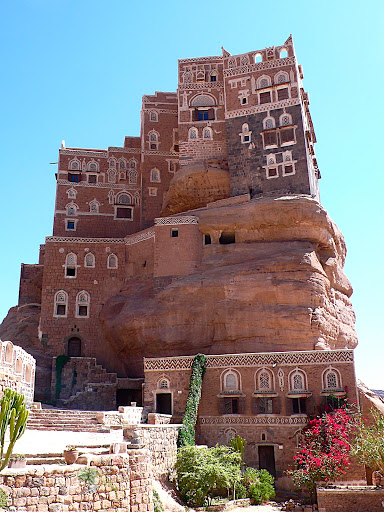


Sana'a old city view, photo by: Island Spice, used under Creative Commons License(By ND 2.0)File:Sanaa.JPGFile:Bab Al Yemen Sanaa Yemen.jpg

the Great Mosque of Sana'a

Salt Market , Suq al-Milh

The Bāb al-Yaman (Yemen Gate)

The majestic 7th-century Jami' al-Kabir

Thursday, August 18, 2011

Travel Plovdiv,Bulgaria Attractions ,The oldest city in the world.


Plovdiv is the second-largest city in Bulgaria after Sofia with a population of 338,153 inhabitants according to Census 2011. Plovdiv's history spans some 8,000 years, with traces of a Neolithic settlement dating to roughly 6000 BC; it is one of the oldest cities in the world. Some sources include Plovdiv among Europe’s oldest continuously inhabited cities. It is the administrative center of Plovdiv Province in southern Bulgaria and three municipalities (Plovdiv-city, Maritsa and Rodopi) and Bulgaria's Yuzhen tsentralen planning region (NUTS II), as well as the largest and most important city in Northern Thrace and the wider international historical region of Thrace. The city is an important economic, transport, cultural and educational center. The oldest American educational institution outside the United States was founded in Plovdiv in 1860, it was later moved to Sofia – today’s American College of Sofia.
Known in the West for most of its history by the Greek name Philippopolis, it was originally a Thracian settlement before becoming a major Roman city. In the Middle Ages, it retained its strategic regional importance, changing hands between the Byzantine and Bulgarian Empires. It came under Ottoman rule in the 14th century. In 1878, Plovdiv was made the capital of the autonomous Ottoman region of Eastern Rumelia; in 1885, it became part of Bulgaria with the unification of that region and the Principality of Bulgaria.

Plovdiv is situated in the southern part of the Plovdiv Plain on the two banks of the Maritsa River. The city has historically developed on seven syenite hills, some of which are 250 m (820.21 ft) high. Because of these seven hills, Plovdiv is often referred to in Bulgaria as "The City of the Seven Hills".
Plovdiv is host to economic and cultural events such as the International Fair Plovdiv, the international theatrical festival "A stage on a crossroad", the TV festival "The golden chest". There are many remains preserved from Antiquity such as the Ancient amphitheatre, Roman odeon, Roman Stadium, the archaeological complex Eirene and others.

Plovdiv was given various names throughout its long history. It was originally a Thracian settlement by the name of Eumolpias, named after the mythical Thracian king Eumolpos, son of Poseidon.Philip II of Macedon conquered the area in 342-341 BC and renamed the city Philippoupolis of which the later Thracian name for the city, Pulpudeva, is a translation. After the Romans took control of the area, the city was named Latin: Trimontium, meaning the Three Hills. During the Middle Ages the city was known as Philippoupolis in Byzantine Greek and Paldin (Пълдин) or Plavdiv (Плъвдив) in Old Bulgarian, variations of the town's earlier Thracian name. The city was known as Philippopolis in Western Europe well into the early 20th century. The city was known as Filibe in Turkish during the Ottoman Empire.
The asteroid (minor planet) 3860 Plovdiv is named after the city. It was discovered by the Bulgarian astronomer Violeta G. Ivanova on 8 August 1986. Plovdiv Peak (1,040 m/3,412 ft) on Livingston Island in the South Shetland Islands, Antarctica is also named after Plovdiv.

Travel Gaziantep,Turkey Attraction ,The oldest city in the world.

gaziantep kale havadan
Gaziantep is a city in southeast Turkey and amongst the oldest continually inhabited cities in the world. The metropolitan area in the entire Gaziantep Province had a population of 1.3 million as of 2010, making the city sixth most populous in Turkey. The city has two urban districts under its administration, Şahinbey and Şehitkamil.

Gaziantep is the probable site of the Hellenistic city of Antiochia ad Taurum ("Antiochia in the Taurus Mountains"). The ruins of the Doliche (Turkish: Dülük) lie a few kilometers to the north of the city center and they are located in the natural setting of a forest arranged into a recreational area also including picnic and camping facilities.
Gaziantep is one of the most developed provinces of the region and is also one of the oldest, its history reaching as far back as the Hittites. Being the center of pistachio cultivation in Turkey and with its extensive olive groves and vineyards, Gaziantep is one of the important agricultural and industrial centres of Turkey.
In the center of the city stands the Gaziantep Fortress and the Ravanda citadel as reminders of past - the citadel was restored by the Byzantines in the 6th century. The Archaeological Museum, with its important collections from Neolithic and the Hittite ages as well as the Roman and Commagene times, attracts many visitors. A recent addition to the Museum's riches are the Roman mosaics discovered in Zeugma. The surroundings of the city are also full of valuable Hittite remains. The Hasan Süzer House, which has been restored to its original state, now houses the Ethnographical Museum. Yesemek Sculpture Workshop, 30 kilometers south of the town of Islahiye, is one of the world's first of this kind. Some of the other historical remains are the Zeugma (called also Belkıs in Turkish), and Kargamış ruins by the town of Nizip and slightly more to the north, Rumkale.
Gaziantep was ruled by Akkadians, Mitannis, Hittites, Neo-Hittites, Assyrians, Urartians, Babylonians, Persians, Greeks, Armenians, Parthians, Commagene, Romans, Byzantines, Sassanids, and Arabs.

In the first half of the 7th century, Arab armies captured this region. It was passed to the Umayyads in 661 and the Abbasids in 750. During the period of Arab rule, it was ravaged several times by the Eastern Romans (Byzantines). After the disintegration of the Abbasid dynasty, the city was ruled successively by the Tulunids, the Ikhshidids and the Hamdanids. In 962, it was recaptured by the Byzantines (Eastern Romans), and retained by them until the Seljuk conquest in 1067. The regime of the Anatolian Seljuks gave way to the Syria Seljuks in 1086. Tutush I appointed Thoros of Edessa as governor of the region.
It was captured by the Crusaders and united to the Maras Seigneurship in the County of Edessa in 1098. It reverted to the Seljuk Sultanate of Rûm in 1150, occupied by the Armenian Kingdom of Cilicia between 1155–1157 and 1204–1206 and captured by the Zengids in 1172 and the Ayyubids in 1181. It was retaken by Seljuk Sultanate of Rûm in 1218. It was ruled by the Ilkhanate between 1260–1261, 1271–1272, 1280–1281 and 1299–1317 and by the Mamluks between 1261–1271, 1272–1280, 1281–1299, 1317–1341, 1353–1378, 1381–1389 and 1395-1516. It was also governed by the Beylik of Dulkadir, which was a Turkish vassal state of the Mamluks.

The Ottoman Empire captured Gaziantep after the Battle of Marj Dabiq in 1516, during the reign of Sultan Selim I. In the Ottoman period, Aintab was a sanjak centered initially in the Dulkadir eyalet (1516-1818), and later in the Aleppo vilayet (1908–1918). It was also a kaza in the Aleppo vilayet (1818–1908).

In 1923, Antep was removed from the Aleppo vilayet and ceded to Turkey according to the Treaty of Lausanne signed between the Ankara government and the Allies at the end of World War I, together with other parts of northern Syria including Adana, Mersin, Tarsus, Urfa, Kahramanmaraş, and Diyarbakır.


gaziantep kale havadanFile:Gaziantep.jpggaziantep zeugmaFile:Rumkale.jpg

File:Pergamonmuseum - Vorderasiatisches Museum 046.JPG

Recent Post Blog

Popular Posts